What can you not send by courier? UK prohibited items list
Searching for prohibited items on courier UK rules usually means you're standing next to a box and you're not sure it can travel. Fair. The list is longer than most people expect.
Every UK courier refuses dangerous and illegal goods. Plenty also refuse ordinary things like cash and cut flowers in water.
We'd rather you found out now than after a driver turns up and leaves without your parcel.
Lists get updated. Treat this guide as a starting point and check the courier's current terms before you book.
The short answer
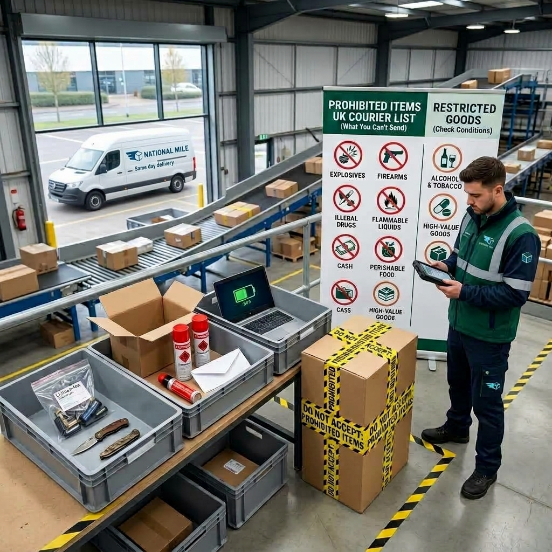
Couriers in the UK refuse anything dangerous or illegal. The exact list changes from company to company. These items get refused almost everywhere:
- Explosives and fireworks
- Firearms and weapons
- Illegal drugs
- Flammable and toxic substances
- Loose or damaged lithium batteries
- Cash and cheques
- Counterfeit goods
- Live animals
- Perishable food
- Human remains
A second group is restricted. Those items can travel, but only with the right packaging or paperwork.
Prohibited vs. restricted: what's the difference?
"Prohibited" means the courier won't take it. Restricted means it might, if you meet conditions on quantity or packaging.
Most confusion sits between those two words. A phone with its battery inside is usually fine. A bag of loose spare lithium batteries usually isn't. Same chemistry, different rules.
Prohibited items on the courier UK lists also differ by company. Royal Mail and DPD each publish their own. They don't match. A same day courier running a dedicated van has its own terms again.
The prohibited items courier UK list in full
Anything on this list gets a flat no. Sending it can also break the law.
1. Explosives and fireworks
Explosives top every list. Fireworks, flares, blasting caps, and party poppers all count. Royal Mail bans Christmas crackers too (a December surprise for plenty of gift senders).
Ammunition gets refused by nearly every carrier as well. One spark in a loaded van is a serious fire risk. No courier will gamble on it.
2. Firearms and weapons
DPD refuses firearms and imitation firearms, along with their components. Tasers, stun guns, pepper spray, and flick knives are banned too (most are illegal to own in the UK anyway).
Replica and deactivated guns get turned away as well. A courier can't easily tell a convincing replica from the real thing. Licensed firearms follow their own legal routes. A standard courier booking doesn't count.
3. Knives and bladed items
Kitchen knives, craft blades, machetes, and replica swords all fall here. DPD lists bladed products as prohibited on its UK network.
UK law also requires strict age checks when knives are sold online and delivered. Plenty of couriers skip the hassle and refuse the job. If you sell blades for a living, you'll need a courier set up for age-verified delivery.
4. Illegal drugs and controlled substances
Cannabis, cocaine, heroin, and LSD are banned outright. So is every other non-prescription controlled drug.
Sending them is a criminal offense. Couriers can hand suspect parcels to the police.
5. Flammable liquids and gases
Petrol, white spirit, lighter fuel, and camping gas are out. So are aerosols with flammable contents, like spray paint. Matches and lighters get refused or tightly restricted by many carriers.
Perfume and nail varnish catch people out. Both are flammable. Many carriers restrict or refuse them, so a gift box with aftershave inside can get turned back.
Vapor builds up fast in a closed van. One spark is enough.
6. Corrosive and toxic substances
Acids, caustic soda, mercury, and rust removers count as corrosives. Rat poison and cyanide are toxic. Radioactive materials get their own strict class of rules.
Small quantities can leak too. A cracked bottle in transit can burn a driver's skin and ruin every parcel beside it.
7. Loose and damaged lithium batteries
Lithium batteries can overheat and catch fire when crushed or short-circuited. Engineers call it thermal runaway. Once it starts, it's very hard to stop.
Spare batteries and power banks travelling on their own get refused by many carriers. Damaged or recalled batteries get refused nearly everywhere. Royal Mail bans lead-acid car batteries too.
Carriers that do accept lithium batteries often cap them at 100 Wh each. For scale, a 20,000 mAh power bank works out at roughly 74 Wh. Laptop batteries typically run 40 to 99 Wh. E-bike batteries often start around 300 Wh.
8. Cash and cash equivalents
Couriers won't carry banknotes or coins. DPD's list adds checks, bank cards, vouchers, and event tickets.
If cash goes missing in a standard service, you usually have no claim. That's a big risk for a few notes in an envelope.
9. Counterfeit goods and forged currency
Fake banknotes and forged stamps fall under the Forgery and Counterfeiting Act 1981. Knock-off trainers and fake designer bags break trade mark law.
Couriers can hand suspect parcels to Trading Standards or the police. The goods vanish and so does your money.
10. Live animals and human remains
DPD refuses living or dead animals, including fish and birds. It also refuses any other living organism, including trees and flowers shipped in liquid.
Human remains are refused too. Ashes have their own rules, so ask first.
11. Perishable food and dry ice
DPD bans perishable food. Fresh meat and dairy all count. A van stuck in traffic won't keep them chilled.
Dry ice releases carbon dioxide, which makes it a dangerous good and a hazard in an enclosed van. The Post Office bans it in the mail. If you need chilled or frozen goods moved, ask for a courier set up for temperature controlled transport.
12. Waste and refuse
Household waste and clinical waste are out, along with used needles. Royal Mail bans waste and refuse but allows soil samples for analysis if the outer packaging contains any leaks.
Clearing a site or a lab? Book a licensed waste carrier. A courier isn't set up for it.
Restricted items: allowed with conditions
These are the grey areas. Whether they travel depends on the courier and the packaging.
Paperwork usually means 1 of 4 things: a safety data sheet, a dangerous goods declaration, a licence or written confirmation from the courier.
13. Alcohol and tobacco
Alcohol rules vary a lot. Some carriers refuse it outright. Others take it if the sender holds the right licence and uses specialist packaging, such as a box with dividers that stops bottles knocking together.
DPD lists tobacco products as prohibited. Nicotine vape liquids get restricted by many carriers too. Selling either online brings legal duties like age checks, so ask your courier before you build a delivery offer around them.
14. Medicines and medical samples
DPD's list bans pharmaceutical products. Royal Mail allows some prescription medicines under strict packaging and quantity limits.
Medical samples are different. Category B biological substances can travel by road when they're packed to UN3373 and P650 rules. That means a leakproof primary container and a leakproof secondary container. Absorbent material goes inside a rigid outer box. Labs and clinics use specialist medical couriers for that work. We run a medical courier service for exactly that.
15. High-value goods
DPD's list refuses jewellery and watches worth more than £250, along with precious metals above the same value. Art and antiques need extra cover even where a courier accepts them.
Standard liability on many services covers only £50 to £100. Check the cover before you book. If the item is worth more you'll want extra insurance. Declare the true value when you book. An under-declared item can leave you short on a claim.
16. Dangerous goods that need ADR handling
Some hazardous goods can travel legally. They need trained drivers, approved packaging, correct labels, and paperwork. In the UK the rules come from ADR, which the Carriage of Dangerous Goods Regulations bring into law.
ADR sorts hazardous goods into 9 classes. Flammable liquids are Class 3, and corrosives are Class 8. Lithium batteries sit in Class 9. Each class has its own labels and packaging codes.
HSE guidance on the carriage of dangerous goods is written for enforcement officers. It's dense, but it shows who carries which duties. Many ordinary couriers don't hold ADR credentials, so ask before you book.
Everyday items that trip people up
Some of the biggest surprises are things you'd never call dangerous.
- E-bikes and e-scooters: the battery sits far above the usual 100 Wh cap, so standard services often refuse them.
- Paint: sealed water-based paint is generally fine. Solvent-based paint and varnish are restricted.
- Hand sanitiser and essential oils: the alcohol makes them flammable. Small amounts sometimes pass. Bulk orders need checking.
- Candles: solid wax candles usually travel fine. Pack the glass so nothing shifts or melts.
- Aerosol deodorant and hairspray: aerosols get restricted or refused by many carriers, even in small cans.
- Used car parts: oil and coolant residue can leak. Ask before you book, especially for anything that held a battery.
- Gift hampers: one bottle of spirits or a jar of fresh food turns the whole hamper into a restricted or perishable parcel.
Packing restricted items properly
Restricted goods that pass the checks still need careful packing. The basics are similar across most carriers:
- Use strong outer packaging with cushioning so nothing rattles.
- Seal liquids in a leakproof container inside a sealed bag.
- Add absorbent material around any liquid.
- Tape over battery terminals and keep batteries in their original packaging.
- Put your name and address on the outside.
Check the courier's own packaging rules too. They can be stricter than these basics.
What to do if your item is banned
Most prohibited goods have a proper route:
- Cash: a bank transfer or a cash-in-transit firm.
- Hazardous chemicals: a carrier with ADR-trained drivers.
- Chilled and frozen food: a courier with temperature-controlled vehicles.
- Blades and other age-restricted goods: a courier set up for age-verified delivery.
- Live animals: a licensed animal transport firm.
- Human remains and ashes: a funeral director.
Why couriers refuse these items
Every ban comes down to 4 things.
Safety comes first. A driver spends the day inches from your parcel. A fire or a leak in a van is a bad way to learn an item was dangerous.
The law comes next. Carrying dangerous goods is tightly regulated. Weapons and drugs bring criminal penalties. The courier can end up liable alongside the sender.
Insurance is the third pressure. Policies exclude prohibited goods. A claim on a banned item usually goes nowhere.
Other people's parcels come last. One leaking bottle on a shared load can wreck dozens of consignments.
A same day courier service sends your goods from A to B in one vehicle, so that last point matters less. The other 3 still apply.
Air travel adds another layer. Some networks fly parcels for part of the journey. Air freight follows ICAO rules that are tighter than road rules for batteries and liquids. That's one reason a parcel network can refuse things a van will carry.
What happens if you send a prohibited item
The best case is a refused collection. The driver checks the contents and leaves. You lose the time and the slot you booked.
Timing makes it worse on a same day job. There's no slack in the schedule. A refusal at collection burns your delivery window. Rebooking somewhere else eats the hours you didn't have.
Worst cases cost more:
- The carrier can dispose of or destroy the parcel and owe you nothing.
- Your insurance cover can be voided.
- You get no automatic right to a refund.
- Serious breaches, like undeclared dangerous goods, can bring fines or prosecution.
Businesses feel this hardest. A refused parcel can hold up a customer's order or a production line.
The sender is responsible for what goes in the box.
How to check before you book
- Read the list for the courier you're booking. Every company's list is a little different.
- Check the safety data sheet if your item is a liquid or powder. Section 14 covers transport classification. Suppliers of hazardous products have to provide one, so ask if you don't have it.
- Read the watt-hour rating on any battery. It's printed on the casing.
- Say what's in the box when you ask for a quote. Guessing costs more than asking. "Laptop, battery installed" beats "electronics."
- Ask about packaging and paperwork for anything restricted.
- Keep photos of the packed item and copies of any invoice or declaration.
Our guide on how to send a parcel same day in the UK covers cut-off times and what to have ready before you get a quote. Prices depend on vehicle and distance. The same day courier cost guide shows how the numbers work.
Sending regularly? Build the check into your process
If you ship every week, put the check on your booking form. Keep an approved products list. Classify anything hazardous once and record it. Tell your courier about the steadily restricted goods up front. Train whoever books the collections. One person who knows the list beats 10 who guess.
A business courier account comes with preferential rates, monthly invoicing, priority bookings, and ongoing delivery support.
Frequently asked questions
Are the rules different for a same day courier than for Royal Mail or Evri?
Often, yes. Parcel networks sort thousands of parcels through shared hubs, so their lists are strict and fixed. A same day courier carries your goods alone in one vehicle, so some items a network refuses may be possible. The law still applies. Ask before you book.
Can I send a laptop or phone with the battery inside?
Usually yes. Most carriers accept devices with the battery installed. The battery should be undamaged and the device packed so it can't switch on in transit. Spare batteries and power banks packed alongside are another matter and often get refused.
Will a courier check what's in my parcel?
Expect the question. Carriers ask what's inside so they can spot banned goods. A wrong answer can void your cover. A parcel that looks wrong or leaks can get opened or refused on the spot.
Who's responsible if a banned item gets booked by mistake?
You are. The sender decides what goes in the box, and the law puts the duty on the sender. An honest mistake still gets the parcel refused. Sending banned goods knowingly can bring fines or prosecution.
Are the rules the same in Scotland, Wales, and Northern Ireland?
The core rules are. Dangerous goods law applies across Great Britain, and Northern Ireland has equivalent regulations. Individual couriers can add conditions for certain areas such as islands, so mention the delivery postcode when you ask.
Can my business send restricted items regularly?
Often yes, with the right setup. You'll usually need classified products, approved packaging, and a courier willing to carry them. Tell your courier what you send and how often. A scheduled collection can suit steady volumes. So can a dedicated van if the goods are bulky.
Check first, then book
Prohibited items and courier UK rules exist to protect drivers and other people's goods. They protect you too from refused jobs and fines. Most refusals are avoidable with a few minutes of checking.
Not sure about an item? Tell us what you're sending, and we'll say yes or no before anyone turns up. Get a free quote or call 0333 335 6517.
National Mile runs same-day deliveries across the UK 24 hours a day.