Picking the wrong van costs you money twice. Go too small and you're making 2 trips when 1 would do. Go too big and you're paying for fuel, parking, and insurance on space you never use.
Most van size guides stop at "small, medium, large, and Luton" and leave you to guess the rest. This one goes further. You'll get real dimensions, payloads, pallet capacity, what actually fits inside each size, and the wheelbase codes (SWB, MWB, LWB) that manufacturers and couriers use but rarely explain. If you'd rather skip the guesswork entirely, National Mile matches the van to your load for you.
Why van size matters for courier work
Every job you take has 3 things that decide which van you need: how heavy the load is, how bulky it is, and how often you're doing runs like it.
A courier carrying documents and small parcels all day needs something cheap to run and easy to park. A courier moving flat-pack furniture or pallets needs load volume above almost everything else. Get the match wrong, and it shows up in your fuel bills, your insurance premium, or the number of jobs you have to turn down because the van's already full.
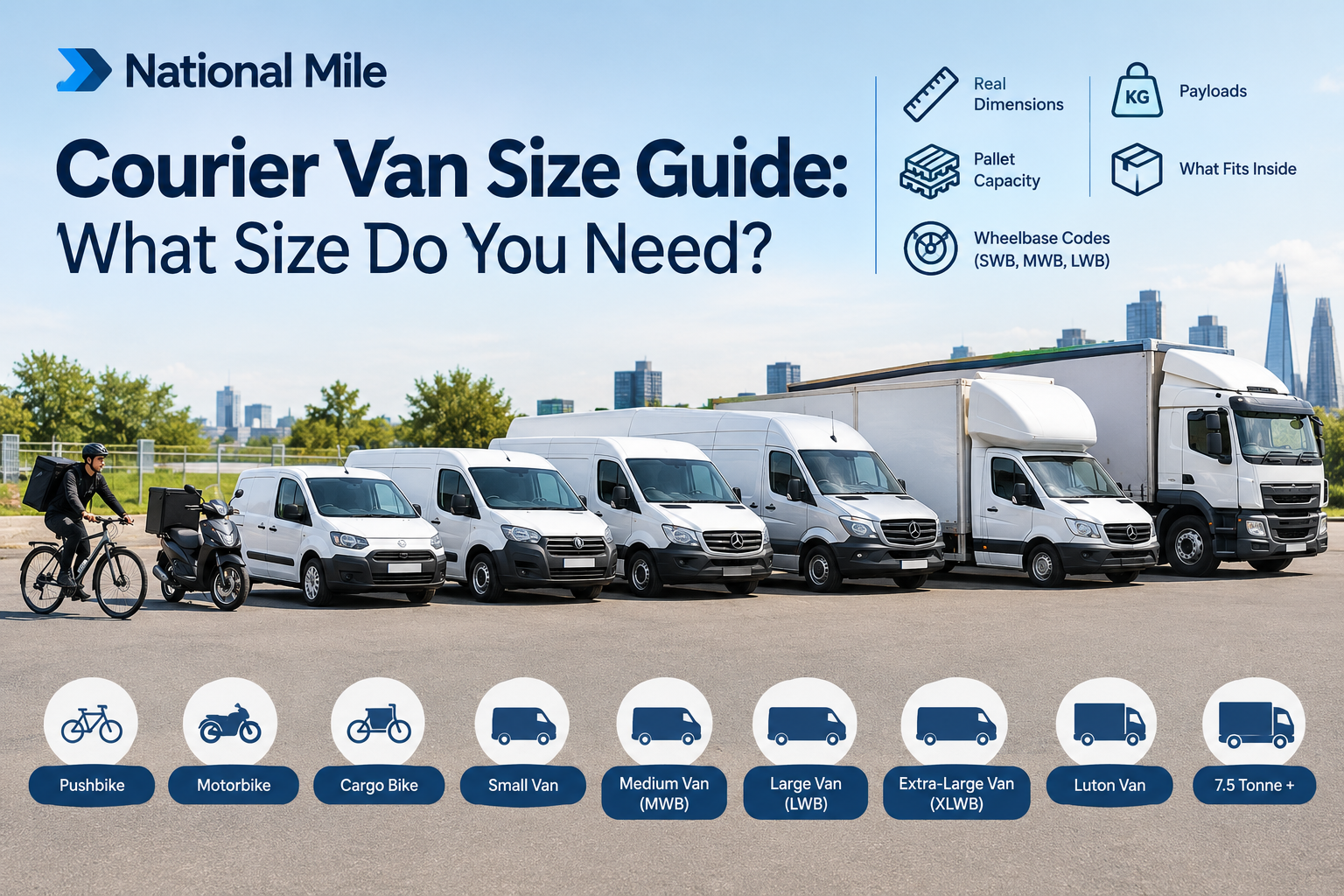
The full range: from bikes to Luton vans
Not every delivery needs a van at all. Here's the full ladder, smallest to largest, so you can see where your job actually sits before you commit to hiring or buying anything.
- Pushbike: a single document or small envelope, a few kilos at most
- Motorbike: small parcels and single boxes, generally under half a normal suitcase weight
- Cargo bike: bulkier city parcels than a motorbike can manage, still well under what a small van carries, and handy for low-emission zones
- Small van: parcels, documents, single small items
- Medium van (MWB): multi-drop rounds, 1-2 pallets
- Large van (LWB): bulk parcels and several pallets
- Extra-large van (XLWB): heavier multi-pallet loads that don't need a full box body
- Luton van: bulky single items, house-move-style loads, the highest pallet count of any panel-based van
- 7.5-tonne and above: full house or office relocations, construction materials
If you're only ever sending single documents or small parcels around a city, a motorbike or cargo bike courier is often cheaper and faster than booking a van. This guide focuses on the van sizes, since that's where most courier and delivery businesses spend their money.
Wheelbase codes explained: SWB, MWB, LWB, and XLWB
You'll see vans described by letters and numbers rather than plain English, and it trips a lot of people up.
The letter tells you which dimension is changing. L stands for length, and H stands for height. So L1H1 is the shortest, lowest version of a model, and L2H2 is longer and taller. Manufacturers use this system (Ford, Mercedes, Volkswagen, and others all do it slightly differently), so an L2 Ford Transit isn't the same length as an L2 Mercedes Sprinter.
Couriers and van hire firms often translate this into simpler wheelbase labels instead:
- SWB (short wheelbase): the shortest version of a mid-size van, closest to a small van in practice
- MWB (medium wheelbase): the standard mid-length version most fleets run day to day
- LWB (long wheelbase): a stretched body for extra floor length and pallet space
- XLWB (extra-long wheelbase): the longest panel van body before you move into a Luton's box shape
Neither system is wrong. SWB, MWB, and LWB describe the job the van does. L1H1, L2H2, and so on describe the exact factory specification. When you're comparing quotes, ask for the actual length and load volume rather than relying on the label alone, since a "large van" at one courier firm might be another firm's "medium."
Small vans: quick and cheap for parcels and light loads
Small vans (think Ford Transit Courier, Transit Connect, and Vauxhall Combo) are built for city driving. They're narrow enough to fit through tight streets, easy to park, and cheap on fuel compared to anything bigger.
Typical numbers for this class:
- Ford Transit Courier: 4,157 mm long, 2.3 m³ load volume, payload up to 850 kg
- Ford Transit Connect (SWB): 4,418 mm long, 2.9 m³ load volume, payload 630-900 kg
- Vauxhall Combo L1H1: 4,403 mm long, 3.8 m³ load volume, payload 750-1,000 kg
Pallets aren't really what this size is for. A few can just about squeeze in a single Euro pallet if the internal width allows it, but most small vans aren't rated for one at all.
What actually fits: several parcel boxes, a couple of flat-pack items, tools and equipment for a trade job, or a single small piece of furniture like a bedside table or office chair.
If your work is mostly small parcels, documents, or single-item drops, a van this size does the job without the running costs of anything bigger. The trade-off is headroom. Most of these have an internal height around 1.2-1.3 meters, so you're loading from the side or crouching in the back rather than walking upright.
If this sounds like your typical job, our same-day courier service runs exactly this size of van for fast city drops.
Medium vans: the courier workhorse
This is the size most courier fleets are built around, and for good reason. The Ford Transit Custom, Renault Trafic, and Peugeot Expert all sit in this bracket, and they hit a sweet spot between capacity and maneuverability.
- Ford Transit Custom (SWB): 5,340 mm long, 6.0 m³ load volume, payload 1,000-1,370 kg
- Renault Trafic L2H1: 5.486 mm long, 8.6 m³ load volume, payload 1,100-1,400 kg
- Peugeot Expert L2H1: 5,309 mm long, 6.1 m³ load volume, payload 1,000-1,400 kg
Pallet capacity varies a lot by operator and exact model, but a medium van generally takes a single standard pallet comfortably, and sometimes 2 if they're arranged carefully.
What actually fits: a multi-drop parcel round, several boxes of stock, a washing machine or small fridge, flat-pack furniture for a studio or 1-bedroom flat, or a couple of pallets for a trade delivery.
At around 1.9-2.0 meters internal height, most people can stand up inside a Transit Custom. That matters if you're loading and unloading dozens of times a day. If you only buy or hire one van for courier work, this is usually the size to pick. Running this size regularly for your business? A business courier account gets you preferential rates and priority booking instead of paying one-off prices every time.
Large vans (LWB): pallets and bulky freight
When the loads get heavier or bulkier, a long-wheelbase panel van steps in. The Ford Transit LWB and Mercedes Sprinter L2H2 fall here.
- Ford Transit L3H2: 6,704 mm long, 12.8 m³ load volume, payload 1,300-1,850 kg
- Mercedes Sprinter L2H2: 6,940 mm long, 11.0 m³ load volume, payload 1,200-1,700 kg
- VW Crafter L3H3: 7,391 mm long, 14.0 m³ load volume, payload 1,300-2,000 kg
An LWB van roughly doubles the pallet count of a medium van, and stacking lighter pallets can push that higher still, though it's worth checking with whoever's supplying the van rather than assuming a fixed number.
What actually fits: bulk stock runs, multiple pallets side by side, or several large appliances at once.
The catch is size on the road. A 6.7-meter van doesn't fit down every residential street, and city parking gets harder. Fuel economy drops too, usually into the low 30s mpg rather than the 40s you'd see on a small van.
Extra-large vans (XLWB): the step before a Luton
Between a long-wheelbase panel van and a full Luton sits the extra-long wheelbase, or XLWB. It's still a panel van shape rather than a box body, but it's stretched to squeeze in more length and, usually, another pallet space or 2.
XLWB panel vans typically run 1,100-2,000 kg payload and sit just under a Luton's pallet count, since the extra length adds another pallet row or 2 over a standard LWB. The advantage over a Luton is fuel economy and a lower overall height, since there's no box built up over the cab. The trade-off is the load area still tapers around the wheel arches, so it doesn't pack quite as efficiently as a true box body.
This size suits couriers who need more pallet space than a standard LWB gives them but don't want the extra height and width of a Luton and don't need a tail lift.
Luton vans: boxy, tall, and built for volume
A Luton van is a different shape entirely. Instead of a panel body, it has a box built over the cab, giving you a full rectangular load area with no wheel arches or curves eating into the space.
Standard 3.5-tonne Luton specs:
- Load length: around 4.0 m
- Load width: around 2.0 m
- Load height: around 2.2 m
- Load volume: 17-20 m³
- Payload: 1,000-1,200 kg
A Luton carries noticeably more pallets than a long-wheelbase panel van of a similar overall length, since the box shape uses the full width and height with nothing lost to wheel arches or a curved roofline. That box shape also means you can stack right to the ceiling and pack pallets flush against the walls without wasting space.
What actually fits: a few large pieces of furniture at once, several appliances, or a mixed load of retail stock and boxes stacked floor to ceiling.
Some Lutons are built with a curtainside body instead of a solid box, which lets you load from the side as well as the back, useful for pallets that need a forklift rather than a tail lift. Most Lutons also come with a tail lift as standard or as an option, which turns loading heavy or awkward items from a 2-person job into a 1-person one.
The downside is the height and width above the cab. Low bridges, tight car parks, and overhanging trees all become a problem you didn't have with a panel van.
Beyond Luton: 7.5-tonne and larger options
If a 3.5-tonne Luton still isn't enough, the next step up is a 7.5-tonne Luton or box truck. These typically load 6+ meters in length, close to 2.4 meters in height and width, and carry payloads well over double a standard Luton's.
This size covers full 3- to 4 bedroom house moves, multi-story office relocations, or bulk construction material deliveries. Beyond 7.5 tonnes, couriers move into 18-tonne rigids and articulated lorries, which cover industrial-scale relocations rather than typical courier work.
The important catch: driving anything over 3.5 tonnes gross weight needs additional license entitlement beyond a standard UK car license (category B). If you're hiring rather than driving yourself, this only matters for checking the operator has the right licensed drivers, but it's worth asking about upfront on anything this size.
Luton vs. transit courier: which is right for your work?
This is the comparison most couriers actually need to make, so here's how the 2 stack up directly.
Transit Custom (medium panel van)
- Load volume: 6-8.6 m³
- Payload: 1,000-1,400 kg
- Pallet capacity: usually 1, sometimes 2
- Load shape: tapers around wheel arches
- Tail lift available: rarely
- Manoeuvrability: good in cities
- Fuel economy: better
- Best for: multi-drop parcels, pallets, mixed loads
Luton box van
- Load volume: 17-20 m³
- Payload: 1,000-1,200 kg
- Pallet capacity: the most of any van in this guide
- Load shape: full rectangular box
- Tail lift available: usually standard
- Manoeuvrability: wider, harder to park
- Fuel economy: worse
- Best for: furniture, house moves, bulky single loads
The short version: pick a Transit-style van for speed, fuel savings, and easier parking. Pick a Luton when the load itself needs a full box shape or a tail lift, and you're willing to trade some manoeuvrability for it.
Van dimensions for delivery: quick sizing table
Here's every class side by side, so you can match a job to a van size in one look.
Small (Transit Courier/Connect)
- Length: 4.1-4.4 m
- Internal height: 1.2-1.3 m
- Load volume: 2.3-3.7 m³
- Payload: 630-900 kg
- Pallets: rarely rated for a full pallet
- Good for: parcels, documents, single-item drops
Medium (MWB, e.g. Transit Custom)
- Length: 5.0-5.3 m
- Internal height: 1.5-1.9 m
- Load volume: 6.0-8.6 m³
- Payload: 1,000-1,400 kg
- Pallets: usually 1, sometimes 2
- Good for: multi-drop, small pallet loads, general courier work
Large panel (LWB Transit/Sprinter)
- Length: 6.7-7.4 m
- Internal height: 2.0-2.6 m
- Load volume: 11-14 m³
- Payload: 1,200-2,000 kg
- Pallets: roughly double a medium van
- Good for: bulk freight, multiple pallets
Extra-large panel (XLWB)
- Length: similar to LWB, stretched further
- Payload: 1,100-2,000 kg
- Pallets: just under a Luton's count
- Good for: heavier multi-pallet loads without a box body
Luton box
- Load length: 4.0 m
- Internal height: 2.2 m
- Load volume: 17-20 m³
- Payload: 1,000-1,200 kg
- Pallets: the highest count of any van on this list
- Good for: furniture, house moves, bulky single loads
What's usually included with a courier van
Beyond the van itself, most professional courier services include basic equipment as standard, and it's worth checking before you book:
- A trolley or sack truck for wheeling heavy items rather than carrying them
- Blankets or furniture pads to stop items scratching in transit
- Straps or tie-downs to stop pallets and boxes shifting
- A tail lift on Luton vans and above, for loading without lifting items by hand
- Basic PPE for the driver on jobs involving heavier or awkward items
If your load includes anything unusually heavy, fragile, or hazardous, ask the courier directly rather than assuming the standard kit will cover it.
How to pick the right van size
Run your job through these questions before you book or buy.
What's the heaviest single item you'll carry?
Payload limits catch people out more than volume does. A van can look empty and still be over its legal weight if the load is dense, like books, tiles, or bagged goods.
How much floor and headroom does the job need?
A sofa needs height and length. A pallet needs floor area and a flat load bay. Match the shape of the load to the shape of the van, not just the total cubic meters.
How many pallets are you moving?
If you know the pallet count, work backwards from it. A single pallet fits a medium van, but anything over 3 or 4 pushes you into LWB, XLWB, or Luton territory.
How often are you doing this exact job?
If it's a one-off large item, hiring a Luton for the day beats running one all week for jobs that don't need it. If it's your daily multi-drop round, the running costs of a medium van will beat a Luton over a month.
Where are you driving and parking?
Narrow residential streets, low car park barriers, and tight loading bays all rule out the bigger end of the range. Check the route before the van, not after.
Does the load need special handling?
Fragile, hazardous, or temperature-sensitive goods sometimes need specific vehicle certification or trained drivers on top of the right-size van, so flag this early with whoever you're booking through.
Still weighing it up? Get a free quote and tell us the load. We'll size the van rather than you having to guess.
Mistakes couriers make when sizing a van
Renting or buying based on volume alone is the most common one. A van rated at 8 m³ won't help if your load is a single 3-meter-long item that doesn't fit the internal length. Always check load length and door opening size, not just the total volume figure.
The other mistake is ignoring payload for light-looking jobs. Paper, tiles, tinned goods, and packed boxes are far heavier than they look, and going over payload invalidates insurance on top of being illegal.
FAQs
What size van do I need to carry a pallet?
A standard UK pallet is 1.2 m by 1 m. As a rough guide, a medium panel van fits 1, a long-wheelbase van doubles that, and a Luton fits the most of any van on this list, since its box shape doesn't lose space to wheel arches. Always confirm the exact number with the operator, since it varies by vehicle.
What's the difference between SWB, MWB, and LWB?
They describe wheelbase length within the same van model. SWB is the shortest version, MWB the standard mid-length, and LWB the stretched version with the most floor space. The exact dimensions vary between manufacturers, so always check the actual load length rather than relying on the label.
Can a small van carry a fridge or washing machine?
Usually not without a struggle. Most small vans have an internal height under 1.3 m, which won't clear a standing appliance. A medium van or Luton is the safer choice.
Do I need a special licence for a Luton van?
Most 3.5-tonne Lutons run on a standard UK car licence (category B), as long as the combined weight of van, load, and driver stays under 3.5 tonnes. Larger 7.5-tonne Lutons and above need extra licence entitlement. The DVLA's own guidance on large vehicles you can drive on a car licence covers the exact weight thresholds if you want to double-check before booking a bigger vehicle.
Is a Luton van harder to drive than a panel van?
It's taller and wider above the cab, so wing mirrors and height clearance need more attention. Once you're used to the extra dimensions, day-to-day driving isn't much different.
What's the difference between L1H1 and L2H2 van sizing codes?
L refers to length and H to height. L1H1 is the shortest, lowest version of a model. Higher numbers mean longer wheelbase or taller roof, so an L2H2 carries more volume than an L1H1 of the same van.
Can I use a bike or motorbike instead of a van?
For single documents or small parcels within a city, yes. Motorbikes and cargo bikes are often quicker and cheaper for lightweight, low-volume jobs, and cargo bikes can access low-emission zones a van can't.
How much does van size affect fuel costs?
A lot over a full year. Small vans typically return 45+ mpg, medium vans sit in the high 30s, and large panel vans or Lutons often drop into the low 30s or worse when loaded.
Getting the right van without the guesswork
Matching a van to a job comes down to payload, load shape, pallet count, and how often you'll run it. A small van or even a bike courier handles parcels and light drops well. A medium panel van covers most day-to-day courier work. Large and extra-large panel vans step in once the pallet count climbs, and a Luton takes over once the load needs a full box shape, extra height, or a tail lift.
If you're still not sure which size fits your next job, get a free quote or contact us and we'll match you with the right van for the load.