If you need to move a blood sample, swab, biopsy, or pathology specimen from one site to another, a standard parcel service is not enough. A medical courier UK provider follows strict packaging, temperature, and chain-of-custody rules that keep the specimen usable and the sender compliant with the law. At National Mile, this task is one of the specialist jobs our drivers handle every day.
This guide walks through what counts as a medical specimen, how UN3373 packaging works, what a courier actually needs from you before collection, and how to pick a provider that will not let a delay ruin a test result.
What Counts as a Medical Sample or Specimen?
"Medical sample" is a broad label. In practice, GPs, hospitals, dental practices, veterinary clinics, and private clinics send several types of material via a specimen courier, and each carries slightly different handling rules.
Common specimen types sent by courier
- Blood samples (serum, plasma, whole blood)
- Urine and stool samples
- Swabs (throat, wound, viral)
- Tissue biopsies and histology blocks
- Cytology and Pap smear samples
- Microbiology cultures
- Clinical trial specimens
- Sputum and respiratory samples
Some of these need refrigeration the moment they leave the fridge. Others remain stable at room temperature for hours. Your request form or the receiving lab will usually tell you which category a sample falls into, so always check before you book a medical courier service.
Category A vs Category B specimens
Nearly everything a GP surgery or general hospital ward sends is classed as Category B under UN dangerous goods rules. This covers routine diagnostic material that does not cause serious illness if someone accidentally exposes themselves to it.
Category A covers a small number of high-risk pathogens capable of causing permanent disability or death. These shipments need specialist handling, additional documentation, and, often, a different type of transport altogether. If your laboratory has flagged a sample as a suspected Category A pathogen, tell the courier at the point of booking. Do not assume a general same-day driver can take it.
Is It Legal to Send Medical Samples by Courier in the UK?
Yes, sending medical samples by road courier is legal and happens thousands of times a day across the NHS and private healthcare sector. The catch is that it is legal only when the specimen is classified, packaged, and labeled correctly.
UN3373 and the Carriage of Dangerous Goods Regulations
Most diagnostic specimens are assigned the UN number UN3373, with the shipping name "Biological Substance, Category B." Transport by road in the UK falls under the Carriage of Dangerous Goods and Use of Transportable Pressure Equipment Regulations, which point back to the international ADR packaging rules for this UN number.
The packaging standard you need to follow is called Packing Instruction P650. It sets out how the specimen must be triple-packaged, marked, and labeled so it survives normal handling, minor knocks, and small pressure changes without leaking. Some specimens, such as those already tested and confirmed to pose no infection risk, are classed as "exempt human specimens" and do not need full UN3373 packaging, though good practice still applies.
Who is responsible: sender, courier, or receiving lab?
This step causes more confusion than any other part of the process. The sender (the GP surgery, clinic, or hospital department preparing the specimen) is legally responsible for correctly classifying and packaging it before it ever reaches the driver. The courier is responsible for transporting it safely, keeping it at the agreed-upon conditions, and not opening or interfering with the package. The receiving lab is responsible for confirming that what arrived matches what was sent.
A courier can advise on packaging and supply compliant kits, but they cannot classify your sample for you. If in doubt, ask your lab's pathology reception or infection control team before you book a collection.
How to Package a Medical Sample for Courier Transport (P650 Compliance)

Correct packaging is the single biggest factor in whether a specimen arrives usable. If it's entered incorrectly, the lab may reject the sample, requiring the patient to be recalled for another test.
The triple packaging system
P650 packaging works on three layers, and each one has a specific job:
- Primary receptacle: The tube, pot, or bottle holding the actual specimen. It must be leak-proof for liquids and sift-proof for solids, with the lid tightened securely.
- Secondary packaging: A sealed, leak-proof bag or container that wraps the primary receptacle. Absorbent material sits between the two layers, in enough quantity to soak up the full volume of the specimen if the primary receptacle fails.
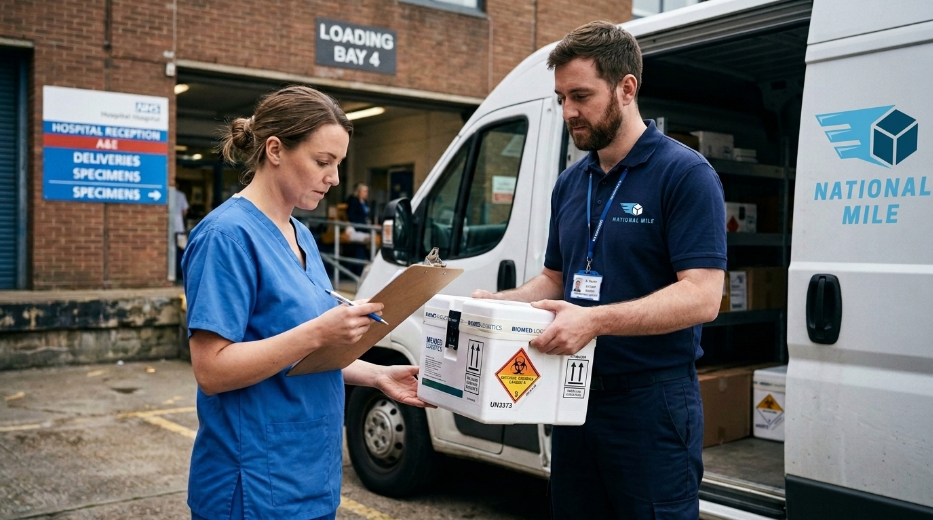
- Rigid outer packaging: A box or carrier strong enough to survive a drop from around 1.2 meters, at least 100 mm on its smallest side, and clearly marked with the UN3373 diamond and the words "Biological Substance, Category B."
Packaging checklist before collection
- The lid on the primary container is tightened and checked for leaks
- The request form is placed in the outer pocket of the transport bag, not inside the specimen bag itself
- Absorbent material is packed between the primary and secondary layers
- Multiple fragile containers going to the same destination are individually wrapped or separated
- UN3373 diamond and "Biological Substance, Category B" wording is visible on the outside
- The sender's name, address and contact number are on the package
- Any temperature requirement (ice pack, cool box, ambient) is noted clearly for the driver
Most hospitals and reference laboratories supply pre-assembled specimen bags to GP surgeries specifically so staff do not need to build P650 packaging from scratch every time.
Choosing a Medical Courier UK Service for Pathology Delivery

Not every same-day courier company is set up for pathology work, even if their website lists "medical" as a service. Here is what actually matters when you are comparing providers.
What to look for in a specimen courier
- Drivers trained in handling biological material and infection control basics
- Willingness to follow your packaging and temperature instructions exactly, rather than improvising
- Clear collection windows, ideally with a defined maximum time from call to arrival
- Proof of delivery with a timestamp, and ideally a signature at both ends
- Insurance that actually covers the type of consignment you are sending
- A dedicated vehicle rather than a shared multi-drop van, so your sample is not sitting alongside unrelated parcels for hours
Same-day vs scheduled specimen courier options
Some healthcare providers need a specimen moved once, urgently. Others need the same route run every morning and afternoon, week after week. National Mile's same-day courier service is built for the first scenario, with rapid collection and a dedicated vehicle for time-critical pathology deliveries.
Same-day/on-demand collection is best for urgent one-off specimens. Collection typically happens within the hour, using a dedicated vehicle that goes directly from pickup to the lab. It is priced per job but offers high flexibility since you can book it whenever you need it.
Scheduled route collection is ideal for daily GP-to-lab runs. Pickups happen in fixed morning or afternoon slots, often as part of a multi-stop round shared with other clinics. Pricing is usually a set rate per route, though the timetable is fixed rather than flexible.
If your surgery or lab has a recurring pattern of specimen collections, a scheduled arrangement usually works out more cost-effective. For urgent, unplanned, or non-routine collections, booking an on-demand medical courier in the UK is the safer option.
Step-by-Step: How to Book a Specimen Courier
- Please confirm the specimen type and temperature requirement with your lab or request form before calling anyone.
- Package the sample following P650 if it is UN3373, or your lab's exempt-specimen guidance if it qualifies.
- Note the collection and delivery addresses, including any specific ward, reception desk, or loading bay instructions.
- Contact the courier with the specimen type, packaging details, temperature needs, and how urgent the job is.
- Confirm the collection window and ask how you will be updated if the driver is delayed.
- Hand the package over directly to the driver, never left unattended at a reception desk or in a corridor.
- Keep your proof of delivery, especially for anything tied to a clinical trial or audit trail.
Costs of Medical Sample Courier Services in the UK
Pricing for a specimen courier depends on several variables, and providers rarely publish a flat rate because the job itself changes so much from one booking to the next.
- Distance. Longer runs cost more, straightforwardly.
- Urgency. Immediate dedicated collection costs more than a planned window.
- Vehicle type. A small van suits most specimens; larger vehicles cost more.
- Time of day. Out-of-hours, weekend, and bank holiday collections carry a premium.
- Route type. A dedicated one-off job usually costs more per mile than a shared scheduled round.
For a single urgent specimen within a city, please expect a fixed quote agreed upon before the driver sets off, rather than a per-mile estimate that may change mid-journey. It’s best to request the total price upfront, rather than just an hourly rate.
Common Mistakes When Sending Medical Samples by Courier
- Leaving the sample unpackaged until the driver arrives. This causes delays and increases the risk of a rushed, non-compliant pack.
- Assuming that any same-day courier can handle biological material is risky. Please ensure that the driver has the relevant training.
- Skipping the request form or paperwork. Labs will often reject or delay processing an unidentified specimen.
- Storing samples in the wrong place while waiting for collection. Fridges, radiators, and car boots are all common culprits.
- Not telling the courier about a Category A suspicion. This situation is a safety issue for the driver as well as a compliance one.
- Overpacking multiple specimens into one bag without separation. This risks cross-contamination and breakage.
Most rejected specimens are due to one of these six mistakes, and nearly all of them can be avoided with a five-minute review before the driver arrives.
FAQs
Can a normal courier company legally transport blood samples?
Only if the company and driver follow UN3373 and P650 packaging and handling rules. A general parcel courier without training in biological substances should not be used for diagnostic specimens.
How quickly does a blood or microbiology sample need to be collected?
It depends on the test. Some microbiology specimens, such as blood cultures, are often needed at the lab within two to four hours of collection to keep results reliable. Always check the request form for a specific window.
Do I need special packaging for every specimen I send?
Most human diagnostic specimens fall under UN3373 and need P650 triple packaging. Some specimens that have already tested negative for infection risk may qualify as "exempt human specimens" and can use simpler packaging, but check with your lab first.
What happens if a specimen arrives at the wrong temperature?
Many labs will reject or flag the result as unreliable if the temperature log shows the specimen went outside its required range. This scenario is why temperature monitoring and insulated packaging matter, particularly for cultures and clinical trial samples.
Can I send veterinary samples using the same rules?
Yes, veterinary diagnostic specimens are covered by the same UN3373 classification as human specimens when they are being transported for diagnosis or investigation, and P650 packaging applies in the same way.
Is a specimen courier different from a general pharmaceutical courier?
Related but not identical. A specimen courier moves samples from a patient or clinic to a lab for testing, while a pharmaceutical courier typically moves medicines and treatments in the other direction. Some providers cover both.
Final Thoughts
Sending a medical sample by courier in the UK requires three things: correct classification, compliant P650 packaging, and a driver who understands what they are carrying. Get those right and the process is straightforward, whether it is a single urgent biopsy or a daily GP-to-lab round.
If you need a reliable medical courier UK partner for pathology delivery, specimen transport, or urgent diagnostic samples, National Mile offers dedicated same-day collection with proof of delivery on every job.
Browse our full range of courier services or get in touch with our same-day team for a quote on your next specimen collection.